

External beam radiation
Most patients will be treated in a vault lined with lead and behind heavy doors which block X rays and high energy neutrons. This is engineered to protect the staff and general public from the primary radiation beam as well as scattered radiation leaving the head of the linear accelerator and patient. There are radiation detectors in the room which notify the radiation therapists when radiation is being produced, and the machine cannot turn on when the vault door is open. This is important since the radiation is otherwise invisible to our senses! When treatment is finished, no radiation is left in the patient and they can go home without any precautions.
Pluvicto and Lutathera
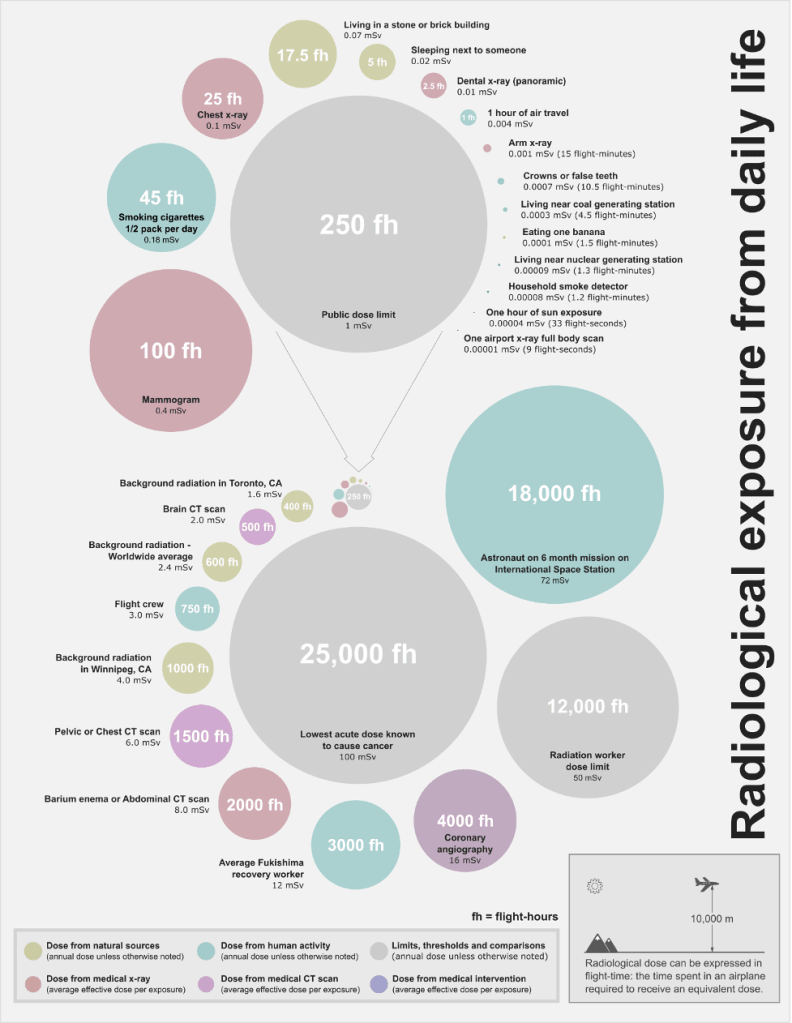
Radiopharmaceuticals are injected into the blood, taken up by the cancer cells, and excreted out of the urine and other bodily secretions. Prior to release from the clinic, a radiation survey meter will verify that the exposure at one meter is < 50 micro-Sieverts (uSv) per hour. A chest X ray is 100uSv and a mammogram is 400uSv exposure to a patient, for reference. The exposure rate to family and caregivers can be minimized by staying in separate rooms. Just increasing the distance from 1 meter to 2 meters reduces the radiation exposure 4-fold. Both Pluvicto and Lutathera are rapidly excreted in the urine with 50% of the dose excreted by 4 and 6 hours, respectively.
Patients who receive this therapy are most radioactive the first three days after their injection. During this time, if clothing or other materials get contaminated with urine or vomit, we recommend containing the materials in a plastic bag and storing it in a remote location (e.g. garage) where the radioactive material can decay safely. The radioactivity decreases every 7 days by half, so by 70 days the amount left will be 0.1% of the original activity.
Healthcare workers that need to draw blood or take care of patients in the first three days should use contact precautions with gowns and gloves. Patient should continue to stay away from children for 7 days and pregnant women for 14 days out of an abundance of caution. Below is a dose equivalency chart for common radiation exposures. If not mentioned, the dose is given per year.
 Reno Cancer Center