

The Goal of Radiation Physics
Every radiation oncology department has a physicist. His/her goal is to verify that radiation is delivered accurately and precisely. The Nuclear Regulatory Commission and American Society of Physicists in Medicine sets safety standards that every department must meet. Quality assurance tests are done daily to verify these standards are being met.
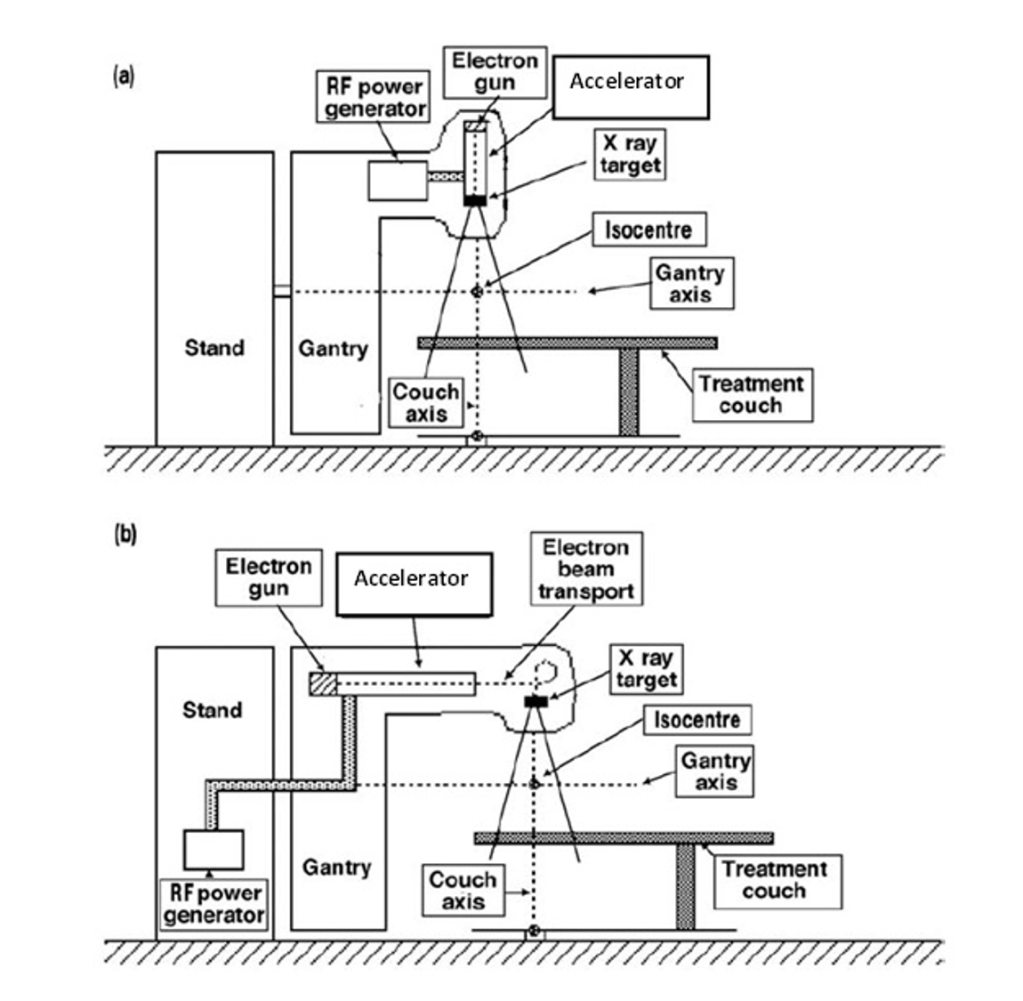
Most patients will be treated on a linear accelerator platform. The schematic below shows the basic parts. Electrons are accelerated through a vacuum tube with high frequency radiowaves to megavoltage energies. When the high energy electrons hit a tungsten metal target, some of its energy gets converted to X rays which are then aimed at the cancer.
Ionizing Radiation

When high energy solar radiation hits the earth’s atmosphere, most is deflected to the magnetic poles where collisions with the air cause the beautiful ionized light display. On a smaller scale, X rays interact with water in our bodies to ionize and form reactive oxygen molecules that can damage proteins and DNA.
The unit of energy absorbed is defined as a Gray (Gy) and is equivalent to one Joule (J) of energy absorbed by 1 kilogram (kg) of matter. Some people “feel hot” after receiving radiation. As the typical dose of daily radiation is in the 2-4Gy range, the physical energy absorbed by a average 1kg volume of tissue would increase temperature by about 1/1000 of a degree Celsius. Therefore, I counsel patients that daily external beam radiation is invisible, doesn’t stay in you, and doesn’t hurt as you receive it. It is possible to have flushed skin in the treated area afterwards, which may be felt as a warm sensation.
 Reno Cancer Center